
A solar system is a 20 to 30 year purchase, yet many buyers spend more time comparing panel brands than reading the warranties behind them. A solar quote usually comes with at least three separate warranties, each covering something different and each backed by a different business. Here is how they work, what they really cover and how to protect yourself.
The three solar warranties at a glance
Think of each warranty as answering a different question. Is the hardware free of defects? Will it keep producing power at the promised level? Was it installed properly? The table below summarises the differences.
| Warranty | What it covers | Who backs it | Typical length* |
|---|---|---|---|
| Product (materials and workmanship) | Manufacturing defects in the panel: delamination, faulty junction boxes, frame or glass defects | Panel manufacturer | Commonly 10 – 25 years |
| Performance (power output) | Output falling below a guaranteed percentage of rated power over time | Panel manufacturer | Commonly 25 – 30 years |
| Installer (workmanship) | Faults caused by the installation: roof leaks, loose wiring, poor mounting | Solar retailer or installer | Varies by business; get it in writing |
| Inverter | Defects and failure of the inverter | Inverter manufacturer | Commonly 5 – 12 years, often extendable |
A 30-year panel warranty is only as good as the company behind it. A warranty from a manufacturer with no Australian presence can be very hard to claim on, no matter how long it is.
Product warranty: covering defects
The product warranty is the manufacturer’s promise that the panel is free of defects in materials and manufacturing. It is the warranty you actually lean on if a panel physically fails, for example if the backsheet cracks, the frame corrodes, water gets into the junction box or bypass diodes fail.
What it usually does not cover is just as important. Damage from storms, hail beyond the panel’s tested rating, falling branches, pests, poor installation or someone walking on the panels generally falls outside the product warranty. Those risks belong to your home insurance or the installer’s workmanship warranty.
Check the fine print for
- Labour and freight. Some warranties replace the panel but leave you to pay for removal, transport and reinstallation, which can cost more than the panel itself.
- Australian contact details. Look for a local office or registered representative.
- Installation conditions. Some warranties require installation by an accredited installer to the manufacturer’s instructions, and may exclude coastal sites very close to the ocean unless the panel is salt-mist rated.
- Transferability. Check whether the warranty passes to a new owner if you sell your home.
Performance warranty: guaranteed output over time
All panels slowly lose output as they age. The performance warranty sets a floor on that decline. A typical document guarantees a slightly lower output after the first year (to allow for initial light-induced degradation), then a small linear decline each year to a stated percentage at year 25 or 30.
For context, a widely cited review by the US National Renewable Energy Laboratory (NREL) of around 2,000 degradation measurements found a median loss of about 0.5% per year for crystalline silicon panels. Modern performance warranties are generally built around similar or lower rates.
| Year | Output at 0.5% per year | Output at 0.8% per year |
|---|---|---|
| 1 | 99.5% | 99.2% |
| 10 | 95.1% | 92.3% |
| 20 | 90.5% | 85.2% |
| 25 | 88.2% | 81.8% |
| 30 | 86.0% | 78.6% |
Claiming under a performance warranty is harder than claiming for a visible defect. You usually need independent test results, measured under standard test conditions, showing the panel is below the guaranteed level. Inverter monitoring data is a useful early warning, but the manufacturer will normally ask for formal testing. That is why the performance warranty matters mostly as a signal of quality and confidence, while the product warranty does the heavy lifting in real-world claims.
Installer (workmanship) warranty
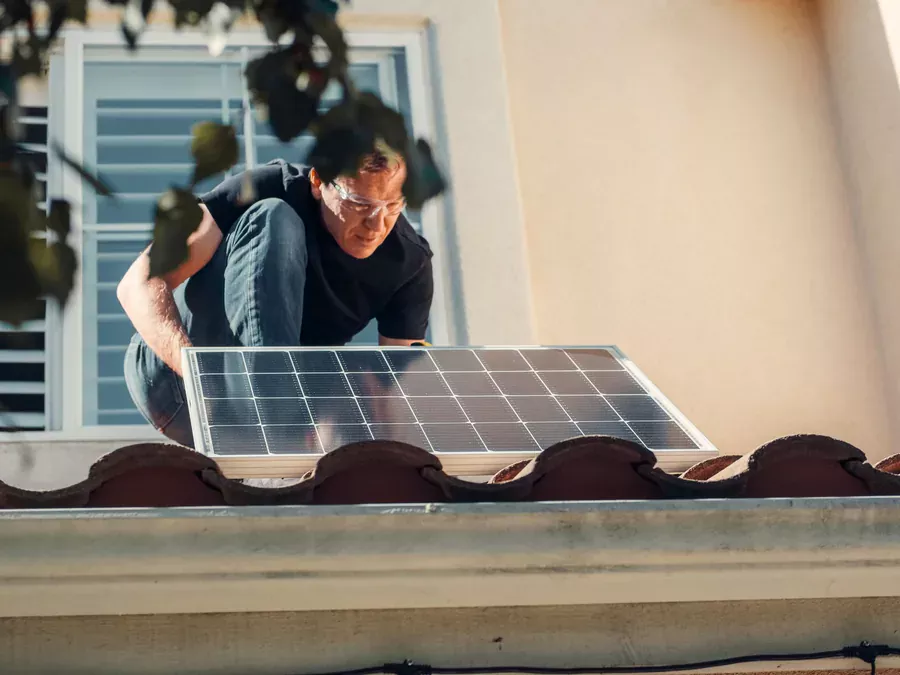
The installer or workmanship warranty covers problems caused by how the system was put in. That includes roof leaks around penetrations, damaged tiles, loose rails, poorly made cable connections, water getting into isolators and conduits, and incorrect settings. Because it is offered by the business you buy from, its value depends entirely on that business still trading when you need it.
When comparing quotes, ask how long the workmanship warranty lasts, whether it covers call-out and labour, and who handles manufacturer claims on your behalf. Read the contract terms carefully. Our solar contract terms and conditions show the kind of detail you should expect in writing, and our complaint handling procedure sets out how issues are resolved.
Check that your installer is accredited with Solar Accreditation Australia (SAA) and holds a current electrical contractor licence. energy.gov.au notes that accreditation belongs to the individual, so you can ask to see the installer’s digital ID on the day.
Inverter, battery and racking warranties
CSIRO notes that inverters, which contain hundreds of components, are responsible for nearly half of all solar system failures. Inverter warranties are much shorter than panel warranties, so it is normal to replace an inverter at least once over a system’s life. Many brands offer optional extensions, and some module-level products such as microinverters and optimisers carry longer warranties. Learn more on our solar inverter page.
Batteries usually carry a warranty defined by years and by energy throughput or retained capacity, whichever comes first. Mounting systems and rails have their own warranties too, which matter in coastal and high-wind areas.
| Component | What the warranty is usually measured in | Questions to ask |
|---|---|---|
| Panels | Years for defects, percentage of output for performance | Is labour included? Is there an Australian office? |
| Inverter | Years, sometimes extendable | Who swaps the unit if it fails? Is there a loan unit? |
| Battery | Years and throughput or retained capacity | What capacity is guaranteed at the end of the term? |
| Racking and rails | Years, subject to installation conditions | Is it rated for coastal or high wind sites? |
| Workmanship | Years, set by the installer | Is call-out included? What if the business closes? |
Your rights under Australian Consumer Law
Manufacturer and installer warranties sit on top of your rights under the Australian Consumer Law (ACL). The ACCC explains that products and services come with automatic consumer guarantees, including that goods are of acceptable quality and that services are provided with due care and skill. These guarantees cannot be excluded by a contract and can apply even after a written warranty has expired, depending on what a reasonable consumer would expect from a product of that type and price.
Be wary of very long warranties on unknown brands or quotes that bundle a “lifetime” warranty with high-pressure sales tactics. The real test is whether the company will still be around and willing to honour it.
How to make a warranty claim
- Keep your paperwork. Store the contract, invoice, panel and inverter serial numbers, warranty documents and the installer’s compliance certificate in one place.
- Record the problem. Take photos, note inverter error codes and export monitoring data.
- Contact your installer first. They are usually best placed to diagnose the fault and lodge the manufacturer claim.
- Escalate in writing if the installer cannot help, contacting the manufacturer’s Australian office directly.
- Get help if needed. Consumer Protection WA can assist with unresolved disputes.
Choosing the right company up front saves most of this effort. See what to look for in our guide to the best solar panel company in Perth.
Frequently asked questions
What is the difference between a product and a performance warranty?
The product warranty covers defects in the panel itself. The performance warranty guarantees the panel will still produce a minimum percentage of its rated power after a set number of years.
Does a solar warranty cover hail or storm damage?
Usually not. Weather damage is normally a home insurance matter. Tell your insurer when you install solar so the system is listed on your policy.
Do warranties transfer when I sell my house?
Many manufacturer warranties do, but terms vary. Check the warranty documents and keep them with your property records for the buyer.
How long should an inverter last?
Inverter warranties are much shorter than panel warranties, so most owners should budget for at least one inverter replacement over a system’s life.
What if my installer goes out of business?
You can still claim directly with the panel and inverter manufacturers, which is why a local manufacturer presence is valuable. Your ACL rights may also apply.
Want a system backed by warranties that mean something?
Future Solar WA uses quality, well-supported brands and explains every warranty in plain English before you sign.
Get a free solar quote- CSIRO – Solar photovoltaics: optimising performance – https://research.csiro.au/infratech/wp-content/uploads/sites/38/2024/12/4393_SolarPhotovoltaicsoptimisingperformance_WCAG.pdf
- Jordan, D. and Kurtz, S. (NREL) – Photovoltaic Degradation Rates: An Analytical Review, Progress in Photovoltaics (2013) – https://doi.org/10.1002/pip.1182
- ACCC – Consumer guarantees – https://www.accc.gov.au/consumers/buying-products-and-services/consumer-rights-and-guarantees
- energy.gov.au – Installation day and after – https://www.energy.gov.au/solar/solar-retailers-and-installation/installation-day-and-after
- Consumer Protection WA – https://www.commerce.wa.gov.au/consumer-protection