
Every solar system needs an inverter to turn the DC power from your panels into the AC power your home uses. The question is where that conversion happens: in one box on the wall, under every panel, or a mix of both. This guide compares string inverters, microinverters and power optimisers so you can match the technology to your roof, budget and plans.
How each inverter technology works
String inverters
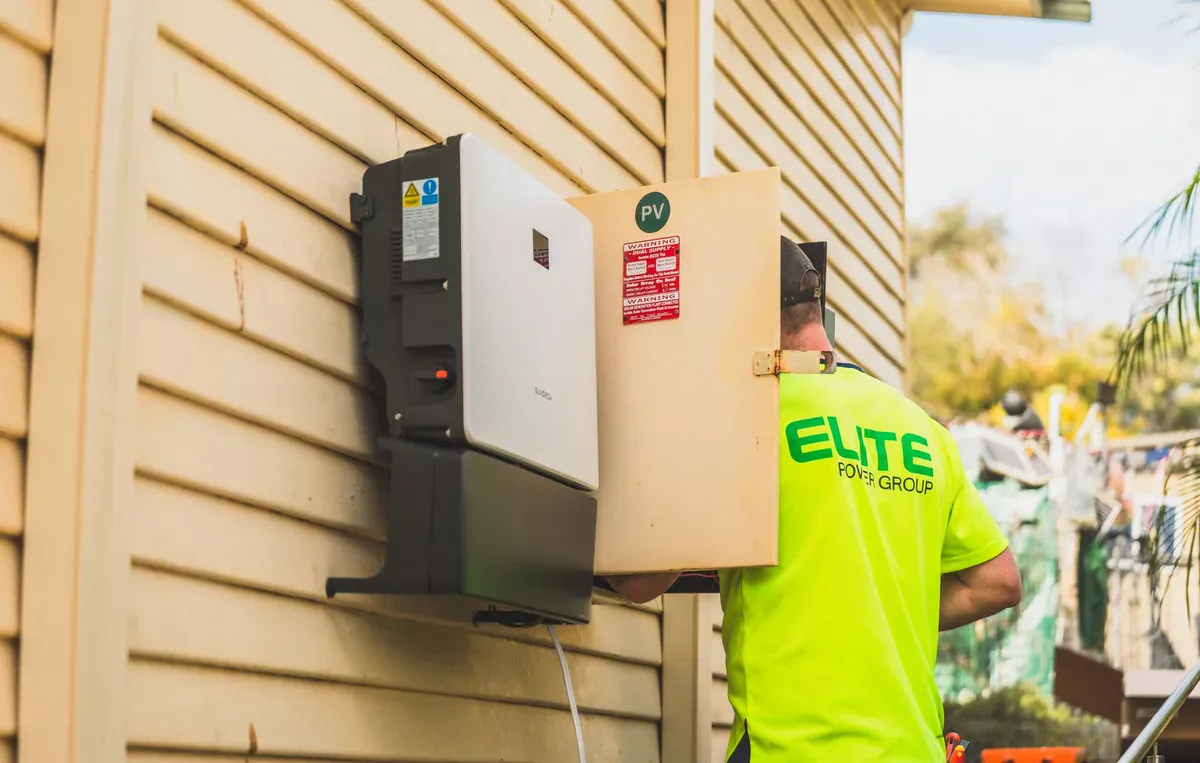
A string inverter is a single unit, usually mounted on a shaded wall or in a garage near the switchboard. Panels are wired in series into one or more “strings”, and the inverter converts the combined DC output to AC. Most modern string inverters have two or more MPPT (maximum power point tracker) inputs, so panels on different roof faces can be handled separately.
Microinverters
A microinverter is a small inverter fitted under each panel (or each pair of panels). Each panel produces AC power independently, so a shaded or dirty panel only affects its own output. There is no high-voltage DC cabling running across the roof, and you can monitor every panel individually.
Power optimisers
Optimisers are a hybrid approach. A DC optimiser sits under each panel and tracks that panel’s maximum power point, then sends conditioned DC power to a central string inverter. You get panel-level tracking and monitoring, while the conversion to AC still happens in one box on the wall.
The main difference is where maximum power point tracking happens: per string (string inverter), per panel with AC output (microinverter) or per panel with DC output (optimiser).
Side-by-side comparison
| Factor | String inverter | Microinverters | String inverter + optimisers |
|---|---|---|---|
| Where conversion happens | One central unit | Under each panel | Central unit, with per-panel DC optimisation |
| Power tracking | Per string or MPPT input | Per panel | Per panel |
| Shading tolerance | Lowest; shaded panels can pull down their string | High | High |
| Monitoring | System or string level | Panel level | Panel level |
| Roof voltage | High-voltage DC on roof | Low-voltage DC, AC on roof | DC on roof, with panel-level safety features on many systems |
| Upfront cost | Lowest | Highest | Middle to high |
| Replacement when faulty | One unit at ground level | Roof access for each faulty unit | Roof access for optimisers, ground level for inverter |
| Battery pairing | Easy with hybrid string inverters | Usually AC-coupled battery | Depends on brand ecosystem |
Shading, orientation and complex roofs
Because panels in a string are connected in series, CSIRO explains that one underperforming module, or even one cell, can affect the output of the entire string. Bypass diodes in modern panels limit the damage, but shading from a chimney, tree or neighbouring building can still cut output noticeably on a plain string system.
| Your roof | String inverter | Microinverters | Optimisers |
|---|---|---|---|
| One unshaded north face | Excellent fit, best value | Works, but higher cost | Works, but rarely needed |
| Two faces, e.g. north and west | Good if each face has its own MPPT input | Excellent | Excellent |
| Three or more small faces | Can be hard to design well | Excellent | Very good |
| Partial shading at some hours | Output losses on affected strings | Best at limiting losses | Very good |
| Small roof, few panels | Fine if string sizing works | Excellent; no minimum string length | Good |
If you are planning a split array, ask your installer to show how each roof face is assigned to an MPPT input or to module-level electronics, and see our solar inverter page for the brands we install. For a simple, unshaded roof, a quality string inverter with dual MPPT inputs is usually the most cost-effective choice.
A note on roof safety and DC cabling
String and optimiser systems run DC cabling from the roof to the inverter, and string voltages can be high. Microinverter systems keep DC voltage at panel level and send AC power down from the roof. All three approaches are safe when designed and installed to Australian Standards by an accredited installer, but they differ in how the system is shut down for roof work or emergencies, so ask your installer to explain the shutdown procedure for your system.
Cost, reliability and warranties
CSIRO notes that inverters contain hundreds of components and are responsible for nearly half of all solar system failures. It also notes that customers are typically offered budget, mid-priced and premium inverters, ranging from about 10% to 25% of total system cost, and recommends weighing lifespan and warranty, not just price.
- String inverters are the cheapest upfront and simplest to service, because a faulty unit is swapped at ground level. Warranties are typically shorter than panel warranties, so plan on at least one replacement over the system’s life.
- Microinverters cost more but spread the risk: one failure takes out one panel, not the whole system. They sit on a hot roof, and replacing one requires roof access, so check whether the warranty covers labour.
- Optimisers add per-panel parts to a central inverter. Optimisers often carry long warranties, while the central inverter is warranted separately.
- How long is each component’s warranty, and does it include labour and call-out?
- Who will attend if a roof-mounted unit fails?
- Is the inverter on the Clean Energy Council approved inverter list?
- Does the brand have an Australian office and local support?
If you already own a string inverter and see an error on the display, our fault code guides for SMA inverters and other brands can help you understand what it means before you call for service.
Batteries, monitoring and future expansion
Batteries. A hybrid string inverter can connect a battery directly on the DC side, which is often the simplest way to add storage later. Microinverter systems typically use an AC-coupled battery with its own inverter. Optimiser systems depend on the brand’s ecosystem. If a battery is on your list, read our solar battery guide and choose an inverter path that keeps the option open.
Monitoring. Panel-level monitoring, standard with microinverters and optimisers, makes it easier to spot a single failing or shaded panel. String-level monitoring is still enough for most simple systems.
Expansion. Microinverter systems are easy to extend one panel at a time. String systems need the inverter to have spare capacity and suitable inputs, so consider your future needs when choosing the inverter size. Our 6 kW solar power system page shows a common Perth configuration.
WA connection rules to know
Whatever technology you choose, it must meet WA network requirements. Synergy and Western Power set inverter capacity and export rules for residential connections, and new or upgraded systems must support emergency solar management or be export limited. The WA Government has also introduced new technical requirements for new and upgraded solar and battery systems from 1 May 2026. Your installer should confirm that the inverter you choose is compatible and configured correctly.
Bigger is not always better. If your panels can produce more than your inverter capacity or export limit allows, some output will be clipped. A good design balances panel capacity, inverter size and your connection rules.
Which inverter suits your roof?
- Simple, unshaded roof and a tight budget: quality string inverter, ideally with dual MPPT.
- Several roof faces or partial shading: microinverters or optimisers.
- Battery planned soon: hybrid string inverter, or a microinverter system with an AC-coupled battery.
- Want panel-by-panel monitoring: microinverters or optimisers.
- Expect to add panels later: microinverters, or a string inverter sized with headroom.
Frequently asked questions
Are microinverters better than string inverters?
Not always. Microinverters handle shading and complex roofs better and offer panel-level monitoring, but cost more. On a simple unshaded roof, a quality string inverter often gives the best value.
Do optimisers fix shading problems?
They reduce the impact of shading on other panels by tracking each panel separately. A shaded panel still produces less, but it no longer drags down the rest of the string.
How long do inverters last?
Inverters generally have shorter warranties than panels, and CSIRO notes they cause nearly half of solar system failures. Budget for at least one replacement over a system’s life.
Can I add a battery to any inverter type?
Yes, but the method differs. Hybrid string inverters can connect a battery directly. Microinverter systems usually use an AC-coupled battery.
Can I mix microinverters with a string inverter?
Some homes do run separate systems side by side, for example when extending an older system. It must be designed and approved as a whole for your connection.
Not sure which inverter fits your roof?
Future Solar WA will assess your roof, shading and plans, then recommend the right inverter setup with a clear quote.
Get a free solar quote- CSIRO – Solar photovoltaics: optimising performance – https://research.csiro.au/infratech/wp-content/uploads/sites/38/2024/12/4393_SolarPhotovoltaicsoptimisingperformance_WCAG.pdf
- Synergy – Distributed Energy Buyback Scheme (DEBS), emergency solar management and export limits – https://www.synergy.net.au/Your-home/Manage-account/Solar-connections-and-upgrades/Distributed-Energy-Buyback-Scheme
- Energy Policy WA – New requirements for small-scale solar and battery systems – https://www.wa.gov.au/organisation/energy-policy-wa/new-requirements-small-scale-solar-and-battery-systems
- Western Power – Connecting solar to the grid – https://www.westernpower.com.au/resources-education/consumer-advice/solar/connecting-your-solar-to-the-power-grid/
- energy.gov.au – Solar system design considerations – https://www.energy.gov.au/solar/solar-system-design/design-considerations